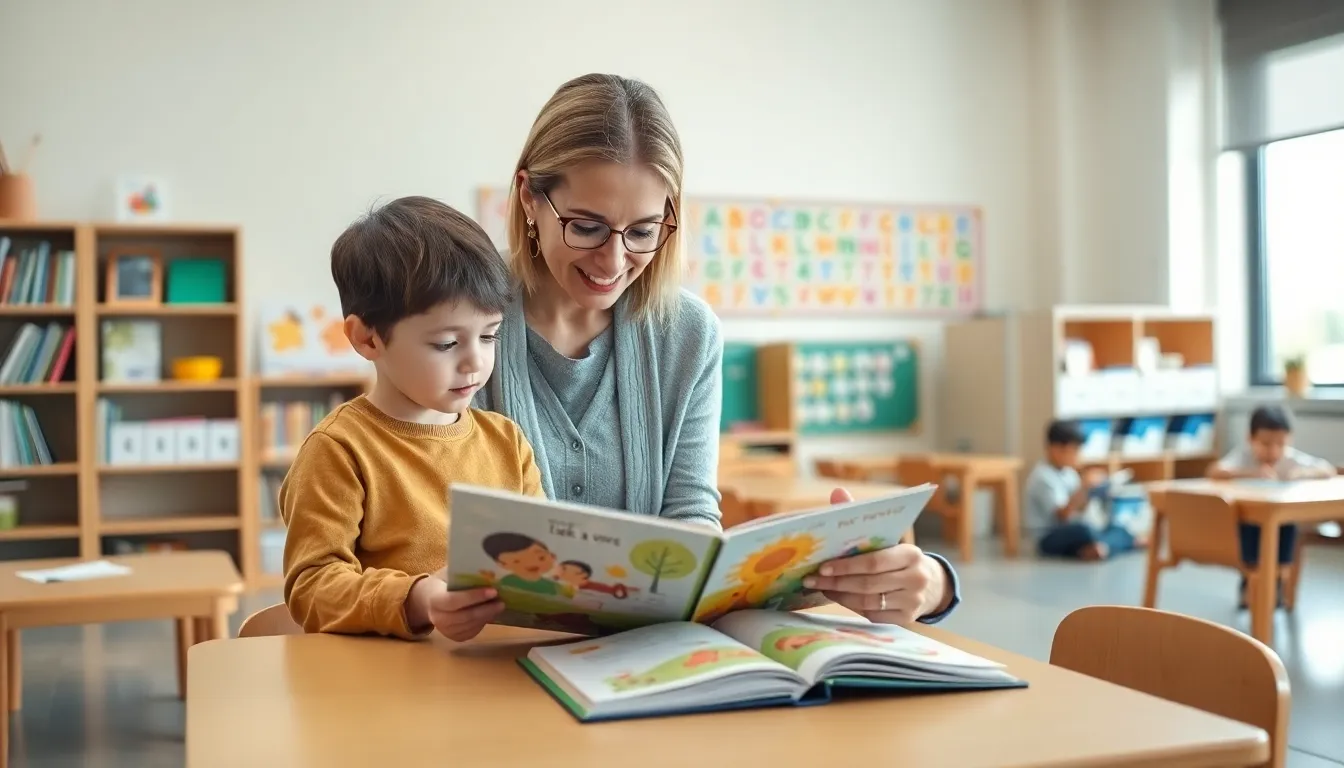
Reading and literacy development examples show how children progress from recognizing letters to analyzing complex texts. Each stage of literacy growth builds on the last, and understanding these milestones helps parents and educators provide the right support at the right time.
A child’s journey with reading starts before they ever hold a book. It continues through elementary school and beyond as they develop fluency, comprehension, and critical thinking skills. This article breaks down specific literacy development examples by age and stage, plus offers practical strategies for readers who need extra help along the way.
Table of Contents
ToggleKey Takeaways
- Reading and literacy development progresses through stages—from print awareness in preschool to critical analysis in middle school—each building on the last.
- Phonological awareness, including rhyming and sound blending, is one of the strongest predictors of future reading success.
- Fluency develops in early elementary through strategies like paired reading, reader’s theater, and repeated readings of the same text.
- Reading comprehension requires active thinking skills such as summarizing, making inferences, and comparing information across sources.
- Struggling readers benefit from early intervention using structured, multisensory approaches like the Orton-Gillingham method and decodable texts.
- A supportive environment that celebrates progress and reduces anxiety helps all readers build confidence and improve their skills.
Early Literacy Skills in Preschool and Kindergarten
Early literacy development begins long before formal reading instruction. Children ages 3 to 6 build foundational skills that predict later reading success.
Print Awareness
Print awareness means understanding that written words carry meaning. Examples of this skill include:
- Recognizing that books are read from left to right
- Pointing to words on a page while an adult reads
- Identifying signs and labels in the environment (stop signs, cereal boxes)
- Understanding that spaces separate words
Parents can build print awareness by running their finger under words during storytime. This simple action connects spoken language to written text.
Phonological Awareness
Phonological awareness is the ability to hear and work with sounds in spoken language. At this stage, reading and literacy development examples include:
- Clapping out syllables in words (ba-na-na = 3 claps)
- Recognizing rhyming words (cat, hat, bat)
- Identifying the first sound in a word (“dog” starts with /d/)
- Blending sounds together (/c/ /a/ /t/ makes “cat”)
Research consistently shows phonological awareness is one of the strongest predictors of reading success. Games like rhyme matching and sound sorting make this practice enjoyable.
Letter Recognition and Early Writing
Kindergarteners typically learn to identify all 26 uppercase and lowercase letters. They also begin connecting letters to sounds, a skill called phonics. Early writing attempts might look like scribbles, but they represent real progress in literacy development.
Examples at this stage:
- Writing their own name
- Copying letters from a model
- Using invented spelling to write words (“luv” for “love”)
- Drawing pictures to tell a story
Building Fluency in Elementary School
Fluency is the bridge between decoding words and understanding them. Students in grades 1 through 3 focus heavily on this skill.
What Fluency Looks Like
Fluent readers read with accuracy, appropriate speed, and expression. They don’t stumble over every word or read in a flat, robotic voice. Instead, they sound natural, like they’re talking.
Reading and literacy development examples for fluency include:
- Reading grade-level text with fewer than 5 errors per 100 words
- Using punctuation to guide pauses and expression
- Adjusting reading speed based on text difficulty
- Rereading phrases to self-correct mistakes
Strategies That Build Fluency
Repetition matters here. Repeated reading of the same passage improves speed and accuracy. Other effective approaches:
Paired reading: A stronger reader and a developing reader take turns reading the same text aloud. The developing reader hears a fluent model and then practices immediately.
Reader’s theater: Students perform scripts without costumes or props. The focus stays on expressive reading. This gives students a reason to reread text multiple times.
Timed readings: Students track how many words they read correctly in one minute. Watching their numbers improve over weeks builds confidence and motivation.
By the end of third grade, most students shift from “learning to read” to “reading to learn.” Fluency makes this transition possible.
Developing Comprehension and Critical Thinking
Reading comprehension becomes the focus in upper elementary and middle school. Students must understand what they read, not just decode the words.
Key Comprehension Skills
Literacy development examples at this level include:
- Identifying main ideas and supporting details
- Making predictions based on text evidence
- Summarizing passages in their own words
- Comparing information across multiple sources
- Drawing inferences from context clues
Comprehension requires active thinking. Passive reading, just moving eyes across a page, doesn’t build understanding.
Teaching Strategies That Work
Think-alouds: Teachers verbalize their thought process while reading. Students hear how skilled readers question, predict, and connect ideas.
Graphic organizers: Visual tools like story maps and Venn diagrams help students organize information. They see relationships between ideas more clearly.
Questioning techniques: Good readers ask questions before, during, and after reading. Teachers model this skill with prompts like “What do I already know about this topic?” and “Why did the character make that choice?”
Critical Thinking and Analysis
Older students analyze author’s purpose, bias, and craft. They evaluate arguments and distinguish fact from opinion. These higher-order reading and literacy development skills prepare students for academic success.
Examples include:
- Identifying persuasive techniques in advertisements
- Evaluating the credibility of online sources
- Analyzing how word choice creates tone
- Comparing different perspectives on historical events
Supporting Struggling Readers With Targeted Strategies
Some students need extra support to develop reading skills. Early intervention produces the best outcomes, but it’s never too late to help a struggling reader improve.
Signs of Reading Difficulty
Watch for these indicators:
- Avoiding reading activities
- Difficulty sounding out unfamiliar words
- Reading very slowly compared to peers
- Poor spelling that doesn’t improve with practice
- Trouble remembering what they just read
Evidence-Based Interventions
Structured literacy programs use systematic, explicit instruction. They teach phonics patterns in a logical sequence and include plenty of practice opportunities.
Reading and literacy development examples for intervention include:
Orton-Gillingham approach: This multisensory method engages visual, auditory, and kinesthetic learning. Students might trace letters in sand while saying the sound.
Decodable texts: These books use only phonics patterns the student has learned. Success with decodable texts builds confidence before moving to more complex material.
One-on-one tutoring: Individual attention allows instruction to match the student’s exact needs. A tutor can identify gaps and address them directly.
Creating a Supportive Environment
Struggling readers often feel embarrassed or frustrated. Adults can help by:
- Celebrating small wins and progress
- Providing audiobooks alongside print versions
- Allowing extra time for reading assignments
- Choosing high-interest, lower-level texts
- Avoiding public reading situations that cause anxiety
With the right support, most struggling readers make significant gains. Patience and consistency matter more than any single program or technique.